Posts

Showing posts with the label Finance

Diversity Programs Don’t Make Companies More Profitable

A new study by two scholars at the University of North Carolina and a professor at Texas A&M examined the impact of DEI programs in corporate America and found no evidence that these programs lead to higher returns. The study reported: “The business case for diversity” is the dominant rhetorical paradigm for how U.S. corporations debate actions and policies around racial/ethnic diversity. In this paper, we conduct an empirical test of the paradigm by gathering data on the race/ethnicity of the individuals shown on the leadership pages of S&P 500 firms’ websites as of mid-2011, 2014, 2017, 2020 and 2021, and then determining if any of nine measures of the racial/ethnic diversity of these executives reliably predict…their firms’ financial performance over the next fiscal year. We do not find reliable evidence that they do. As such, our results do not support the “business case for diversity” when the claim is assessed using 1-year-ahead financial performance metrics and multiple ...

Required Reading: The Richest Man in Babylon

Image
The Richest Man in Babylon  is an absolute gem of a book that imparts timeless financial wisdom in a captivating and relatable manner. George S. Clason's storytelling takes you on a journey to the ancient city of Babylon, where simple yet profound financial principles come to life. This book is a masterpiece in teaching the art of managing money, showcasing principles like saving a portion of your income, investing wisely, and living within your means. Through relatable parables and anecdotes, Clason delivers valuable lessons that remain as relevant today as they were when the book was written. What sets this book apart is its ability to simplify complex financial concepts. The storytelling format makes it engaging and easy to understand, even for those who are new to financial literacy. As you follow the characters' journeys to financial success, you'll find yourself not only entertained but also inspired to apply the lessons to your own life. "The Richest Man in Baby...

Homebuilder sentiment: Foundation Cracks Under Weight of Mortgage Rates

By Stephen Culp , Reuters The mood amongst U.S. homebuilders took an unexpected dour turn this month. The National Association of Home Builders' (NAHB) Housing Market index (USNAHB=ECI) slid five points to land at 45 - the lowest since April - defying analyst expectations that it would hold firm at a neutral 50, which is the dividing line between optimism and pessimism. Coming on the heels of a 7-point drop in August, the residential construction sector is feeling the stress of rising mortgage rates; the average 30-year fixed contract rate has been above the 7% level since early August, and applications for loans to purchase homes are down 27.5% from a year ago, according to the Mortgage Bankers Association. "High mortgage rates are clearly taking a toll on builder confidence and consumer demand, as a growing number of buyers are electing to defer a home purchase until long-term rates move lower," writes Robert Dietz, NAHB's chief economist. Home construction initiall...

Easy Steps Toward an Emergency Fund

Image
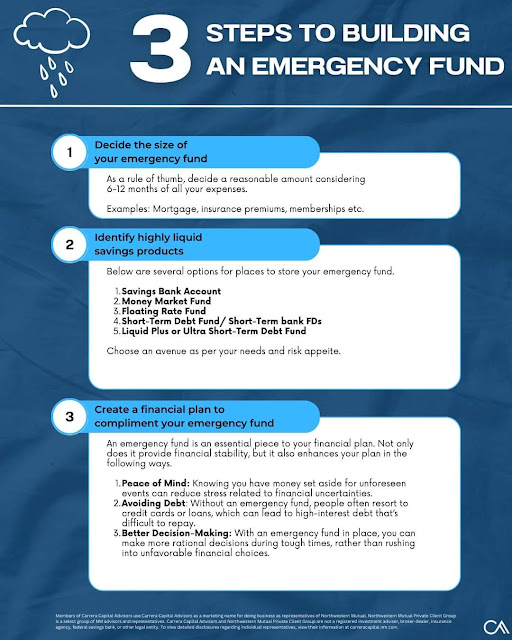
This is your bedrock for all your finances. Without an emergency fund, any other goals you may have, such as investing or saving for a vacation or college, will get derailed. It's difficult to recover.  But first of all, have a budget and follow it. I'm retired now, but still use a budget. It's basic to sound financial planning and peace-of-mind. Recent surveys indicate that 61 percent of American families cannot come up with $400 to meet an emergency. Don't be one of these people. 

Five Things You Should Be Doing In Retirement

From Charles Schwab, Inc . If you've already gone from saving for retirement to living off your savings—or you're still making this shift—it probably doesn't surprise you to hear that retirement doesn't mean an end to your financial responsibilities. "In some ways, they become more important," says Rob Williams, managing director of retirement income and wealth management at the Schwab Center for Financial Research. "As your focus shifts from work to enjoying the fruits of your labor, your planning needs also change," Rob says. "If the priority before was to save enough to retire, the main job now is to preserve and protect—but also use your savings so you can enjoy the retirement you dreamed about." Here are nine things you can do after you retire (or partially retire), to keep your goals on track. 1. Review your spending and income plan at least once a year After years of working and saving, you likely started retirement with a plan for h...

Freddie Mac Mortgage Rates

Image
 Up from 6.09% on Feb. 3, 2023.

What Behavioral Finance Can Teach Us About Investing

By J.P. Morgan Wealth Management Birds and bees are great – but so are brains. In the last few decades, behavioral finance has emerged as a field of study that merges psychology and finance. It’s a subset within the field of behavioral economics, which was developed by, we assume, super smart dudes named Daniel Kahneman and Amos Tversky. In 1979, they proposed the idea of prospect theory, which argues that people make decisions based on the potential value of gains and losses rather than the utility of a decision itself. Their empirical findings challenged the assumption that human rationality prevailed in modern economic theory – and in 2002, Kahneman even won the Nobel Memorial Prize in Economic Sciences. (See, we were right, they are super smart.) To put it simply: investors are humans. We feel greed, fear, hope, excitement – all sorts of emotions impact our behavior on the micro and macro levels. It is precisely because we are human that we often make irrational decisions. Behavior...

Yield Inversions Are Back; Get Very Little Mention In Press

Image
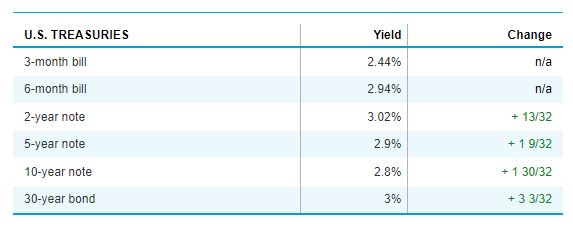
Federal bond yields, when inverted, normally signify an upcoming recession. That's something we've been anticipating for some time, so whether it's a predictor or confirmation, is anyone's guess. It's not the first time yields have inverted in the last year or so.  It's just something all investors should be aware of, and plan for accordingly. I think the overall market has priced in these facts already, with the DJIA down about 15%, the SP500 down 18%, the NASDAQ100 down 25%, and the Russell down 27%.  These declines are up from yearly lows, with rebounds of 5% to 10% in the last month or so. This chart shows the short term bonds have larger yields than the longer term 10-year and 30-year bonds. It should be the other way around. 

Get Lucky and Become a Deadbeat

Image
  A client called one afternoon and said, “I need $50,000 out of my IRA account.” “Uh, ok. Why?” I responded. “To pay off my credit cards. The interest is killing me.” “Yeah, I get that. Why are your credit card debts so high?” “Well, I just don’t make enough money to pay for the things I need.” “Ever thought about getting another job or moving to a less expensive house?” “Nah, I like my job and house.” I fulfilled her request and a year later it repeated. Eventually, her nest egg was, well like Humpty Dumpty. Not exactly sure what she did after that. She never calls. I kind of feel lonely. Now, my wife and I use credit cards. She has a wallet full of them. Different ones for major companies we buy from. They give us discounts or we build points. But every month we pay off the balances. No carryover and no interest. Just convenience and rewards. The credit card companies have a name for people like us: “deadbeats”. No kidding. My wife was talking with a credit card service person r...

What Will the Fed Do? Will It Be Enough?

Fed chair Jerome Powell was appeared before Congress yesterday to give his semi-annual monetary policy report. In no uncertain terms, he backed a rate hike at the Fed's upcoming meeting on March 15-16. Specifically, Powell said he was "inclined to propose and support a 25 basis-point rate hike"-- the kind of plain-speak you rarely hear from Fed chairs, ever, about future tightening plans. Goldman Sachs reiterated their call for seven hikes -- one per meeting -- this year soon after Powell's remarks. The market isn't fully pricing that in yet. Of course everybody is extremely nervous about how poorly events could play out in Ukraine, or even closer to home, based on Russia's continued military action. But as Powell himself noted, we have no idea how those events will play out. What we do know is the impact they already having -- an impact that is undoing the Fed's efforts to tighten and lessen inflationary pressures in the U.S. economy. How so?  (1) Interes...

Inflation Remains High, Jobless Claims Down, Earnings Update

Image
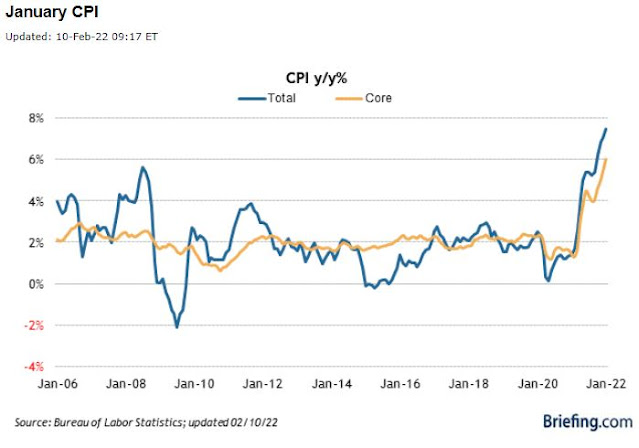
The  Consumer Price Index  (CPI) rose 0.6% month-over-month (m/m) in January, above the Bloomberg consensus estimate of a 0.4% increase, and following December's upwardly-revised 0.6% gain. The  core rate , which strips out food and energy, also increased 0.6% m/m, topping forecasts of a 0.5% gain, and matching December's unadjusted rise. Compared to last year, prices were 7.5% higher for the headline rate—the fastest pace since 1982—above estimates of a 7.3% increase and an acceleration from the prior month's 7.0% rise. The core rate was up 6.0% y/y, above projections of a 5.9% increase, and following December's unrevised 5.5% rise. Weekly initial jobless claims  came in at a level of 223,000 for the week ended February 5, versus estimates calling for 230,000, and down from the prior week's upwardly-revised 239,000 level. The  four-week moving average  declined by 2,000 to 253,250, and  continuing claims  for the week ended January 29 was unchang...

Study Finds Enhanced Jobless Benefits Prolong Unemployment

From the Daily Signal By Patrick Tyrrell & Anthony Kim If common sense and reports from thousands of employers weren’t enough, a recent National Bureau of Economic Research  paper  found conclusively that paying people not to work during the COVID-19 pandemic was why many of them remained unemployed. That  shouldn’t  come as a surprise to anyone, except that last year, major news reports were saying the opposite was true, before the evidence was in. Leave it to the American media to get something important wrong. By comparing states that discontinued the overly generous unemployment benefit programs early against those who retained the payouts for the life of the program, the National Bureau of Economic Research researchers showed: [I]n states that eliminated [the two pandemic-related expanded unemployment benefits programs] in June 2021, the share of 25-to-54-year-old unemployed workers who found employment rose by about 14.4 percentage points in July and August...

Best Investment Strategy for the New Year

In early 2020, I answered the following question posed on Quora :  What will be the best investment strategies for late 2019 going into 2020? Here is the answer I wrote, along with comments today as an update for 2022.  I used this strategy in 2021 and my portfolio returned 16.09% for the year. While not as much as the S&P 500 (about 30%), it did yield 5.9% in income, which was my objective, since I'm retired and looking for income).  I don’t really change my strategy, which is long-term. I may change the allocation of my portfolio, based on current events. While you could be in cash 100 percent right now, you would not have any earnings on your investments. In fact, you’d be losing about 2 percent annually due to inflation. So that’s not a very good strategy. (For 2022, this would be closer to 6 percent inflation). While it is probable that there will not be a recession in the next few months, if we created a strategy that assumed the worse, we might miss the opportu...

I'm in Debt. How Do I Get Myself Out of This Mess?

 I got this question on Quora today. It's a common question. The answer I provided is below.  I got into debt young as I didn’t realize how important it was to have a good credit score. How can I get myself out of this mess? I’m worried it’s going to affect future relationships. You really must to want to be debt-free. There is no other way. It’s a process, of both knowledge of personal finance, and modifying your financial behavior. But it is something you can achieve, if you create a plan and follow the steps of sound financial planning. I’m going to tell you up front that it will take quit a bit of work and effort on your part, depending on how much debt you have, and what you are willing to do. We had a saying in the military about what needed to be done do accomplish our mission: “Whatever is necessary.” This will be the same kind of thing. So you have to develop the same mindset. Be hungry. Personal finance is 20 percent knowledge, and 80 percent behavior. When I starte...

60% of millennials earning over $100,000 say they're living paycheck to paycheck

Image
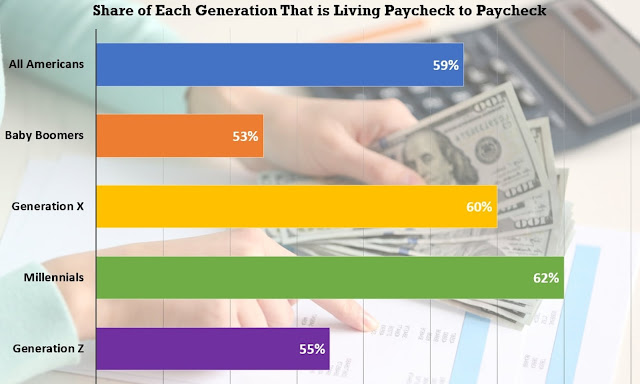
I always suspected that living paycheck to paycheck did not involve your income, but was influenced by bad behavior and outright ignorance of how to handle your personal finances. And throw in some vanity, and you've got a recipe for eating cat food in retirement. Or maybe you'd prefer dog food.  Been there, done that, so I'll include myself in this category, until I shook off the insanity and put things right. I'm on a ribeye diet, nicely retired, thank you. Here are some facts, as reported by Business Insider. In a survey this June, 60% of millennials earning over $100,000 said they live paycheck to paycheck. Some of these millennials - known as HENRYs - prefer a comfortable, expensive lifestyle. In today's economy, $100,000 is considered middle class in the US. High-earning millennials feel broke. Sixty percent of millennials raking in over $100,000 a year said they're living paycheck to paycheck, found a survey this June by PYMNTS and LendingClub, which ana...

Eviction Moratorium Has Expired. Oops. Not Yet.

Update on Aug 5: The moratorium was extended by the CDC, against a ruling by the U.S. Supreme Court.  Landlord Group Sues CDC Over Eviction Ban Extension  The eviction moratorium expired on Saturday, July 31. There has been plenty of speculation about what will happen now, but I don't think anyone is absolutely sure. It could spark an economic nightmare, but is getting little to no coverage in the mainstream media.  In March of 2020, Congress passed the Coronavirus Aid, Relief and Economic Security Act (the so-called “CARES” Act) which included an eviction moratorium preventing landlords from evicting tenants who were delinquent in paying their rent. The national moratorium has been challenged in several courts and its expiration date has been extended four times. It currently expired last Saturday, July 31, and federal officials (including President Biden) have indicated there are no plans to extend it again, though there are those in Congress who wished to have it exten...

Getting Out of Debt

This is a question I get asked a lot on Quora. "What are the best ways to get out of debt?" Here's my most recent answer: You really must to want to be debt-free. There is no other way. It’s a process, of both knowledge of personal finance, and modifying your financial behavior. But it is something you can achieve, if you create a plan and follow the steps of sound financial planning. I’m going to tell you up front that it will take quit a bit of work and effort on your part, depending on how much debt you have, and what you are willing to do. We had a saying in the military about what needed to be done do accomplish our mission: “Whatever is necessary.” This will be the same kind of thing. So you have to develop the same mindset. Be hungry. Personal finance is 20 percent knowledge, and 80 percent behavior. When I started I had more than $50,000 in credit card debt, had two mortgages (one on a rental house that was actually costing me more than I made in rents), and a cou...